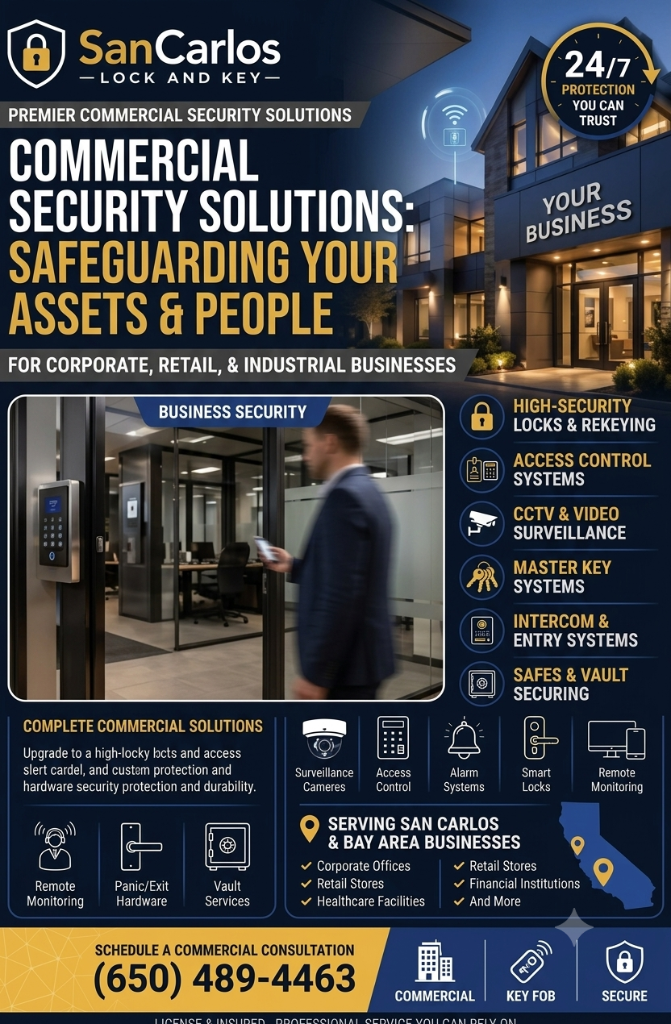
For a San Carlos business, access control is more than a way to unlock a door. A well-planned system helps determine who can enter, which areas they may use, and how access changes when staff or business needs change. Whether you manage a small office, retail space, or multi-tenant workplace, thoughtful planning can make daily entry more secure and orderly.
San Carlos Lock and Key helps businesses in San Carlos, Redwood City, Belmont, Menlo Park, and San Mateo assess locks and entry hardware. Our licensed, bonded locksmith team is available 24/7 at (650) 489-4463 for service needs, including urgent lock and access issues.
Start with a map of doors and responsibilities
Before choosing equipment, list every exterior and interior door that affects security. Include the main entrance, employee entrances, storage rooms, records areas, server or communications rooms, and shared building doors. Note which doors need controlled entry and which should remain freely accessible during business hours.
Then identify the people who need access. Consider employees, managers, cleaning staff, contractors, delivery personnel, and visitors. Avoid giving everyone the same level of access by default. A staff member may need the office entrance but not a file room; a maintenance contractor may need temporary access to a mechanical area but not employee workspaces.
- Define access groups: Group users by role rather than managing each person as a one-off.
- Set schedules: Decide when credentials should work and whether certain doors should remain locked outside business hours.
- Identify exceptions: Plan for deliveries, shift changes, and authorized after-hours work.
- Check existing hardware: Confirm that doors, frames, closers, and locks are suitable for the intended system.
Choose credentials that fit daily operations
Commercial systems may use key cards, fobs, PIN codes, mobile credentials, or a combination. The right choice depends on how employees work, how often access changes, and what happens if a credential is lost. Cards and fobs are familiar for many workplaces, while mobile access can suit teams that already rely on managed devices. PIN entry may be useful at selected doors, but codes should be protected and changed when exposure is suspected.
Ask how the system handles lost credentials, staff departures, and temporary access. A key benefit of electronic access control is the ability to disable an individual credential without changing every door cylinder. That process is only helpful, however, if someone is assigned to maintain the user list and act promptly when access needs to change.
Plan for emergencies and dependable operation
Security should never interfere with safe exit. Access-controlled doors must be coordinated with appropriate egress hardware and applicable building and fire requirements. Do not add a locking device, keypad, or electronic release in a way that prevents occupants from leaving safely. Have door functions reviewed by a qualified professional and consult the relevant authority when a project affects regulated egress routes.
Also consider what happens during a power interruption, network outage, or equipment failure. Ask whether the system has backup power, which doors remain secure, and how authorized users can enter if the normal method is unavailable. Keep mechanical keys or another approved contingency where appropriate, and make sure responsible staff know how to use it.
Set a simple access-management routine
An access control system needs ongoing administration. Assign a primary administrator and a backup. Maintain a record of active users, assigned access groups, and credential status. Review permissions when employees change roles, when contractors finish a project, and whenever a credential is reported missing.
- Remove access promptly when a person no longer needs it.
- Review access groups at regular intervals and after organizational changes.
- Test doors, readers, door closers, and exit hardware as part of building maintenance.
- Document unusual entry problems and request professional inspection if failures recur.
Coordinate electronic controls with physical security
Access control cannot compensate for a door that does not close, a loose strike, or damaged frame hardware. Check that each door latches reliably and that readers are mounted in practical locations. The system should be usable for employees while preserving a clear security boundary for visitors. Reception procedures, visitor sign-in, and staff awareness remain important even when credentials control entry.
Every workplace has different doors, traffic patterns, and safety requirements. San Carlos Lock and Key serves commercial properties in San Carlos and nearby Redwood City, Belmont, Menlo Park, and San Mateo. For help evaluating locks, entry hardware, or a commercial access-control plan, our licensed, bonded team is available 24/7 at (650) 489-4463.